
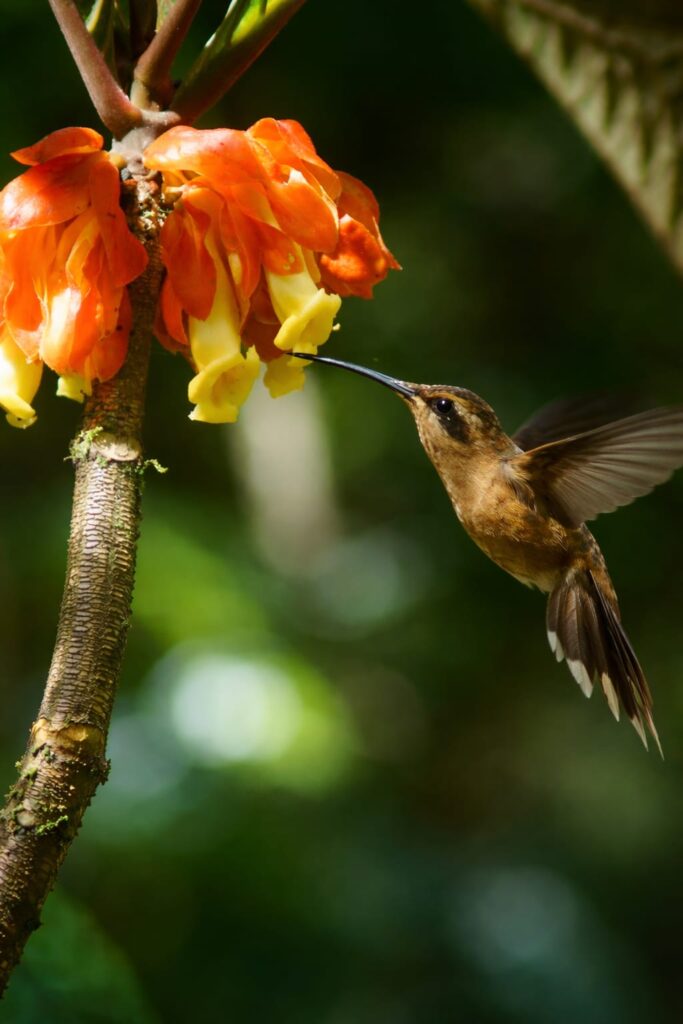
At Cloudbridge Nature Reserve, hummingbirds are a constant presence, darting between flowers, flashing iridescent colors, and fiercely defending feeding territories. But are all species benefiting equally from the way humans shape the landscape? This article is based on a research report by our intern Fergus R. H. Jackson, developed as part of his University dissertation, which explored how human activity influences hummingbird communities across the reserve.
Cloudbridge offers a unique setting to investigate this question. Some areas remain relatively undisturbed, with dense forest and native vegetation, while others, near buildings, trails, and gardens, are more influenced by human activity and often include planted, nectar-rich flowers. By comparing hummingbird activity across these environments, the study revealed important differences in how species respond to habitat change.
Not all hummingbirds interact with their environment in the same way. Some are generalists, able to feed from a wide variety of plants and adapt to changing conditions, including human presence. Others are specialists, relying on specific native flowers and more stable forest conditions. This distinction plays a key role in determining which species thrive and which struggle as habitats are modified.
In human-influenced areas, generalist and dominant species tend to do well. These hummingbirds benefit from abundant and consistent food sources, often provided by planted species that flower for long periods, as well as from more open environments that make it easier to defend feeding territories. As a result, a few adaptable species are frequently observed dominating these areas, often displaying more aggressive behaviors and excluding others.
In contrast, natural forest sites support more dynamic and complex communities. Here, hummingbird presence shifts with seasonal flowering cycles, and a wider range of species, including specialists, can be found. These habitats promote greater variation in community composition and allow for more balanced ecological interactions. However, they are also more sensitive to disturbance, and changes in habitat structure or plant diversity can quickly affect which species are present.
Interestingly, while the total number of species recorded was similar across both habitat types, the structure of the communities differed significantly. Natural areas showed higher variation and species turnover, whereas human-influenced sites were more uniform and often dominated by the same few species, a process known as homogenization. One species observed across all sites was the White-throated Mountain-gem, which was particularly frequent and territorial in human-influenced areas, highlighting how certain adaptable species can strongly influence community dynamics.
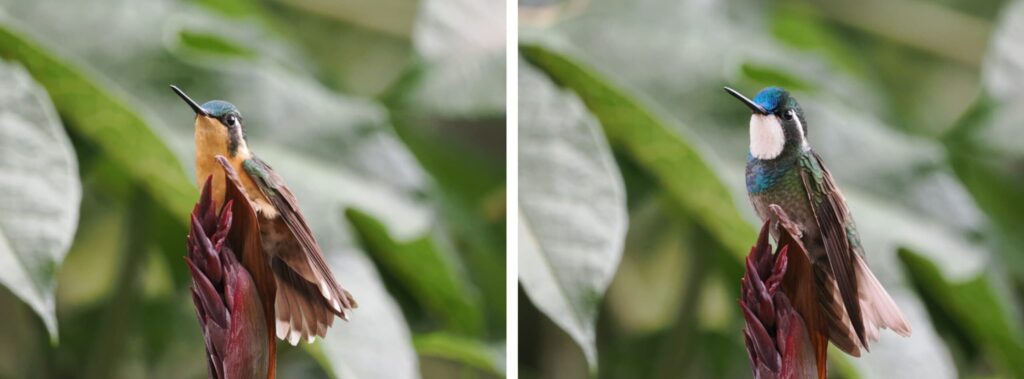
These findings are important because hummingbirds play a vital role as pollinators in cloud forest ecosystems. Changes in their communities can affect plant reproduction, forest regeneration, and overall biodiversity. When generalist species dominate and specialist species decline, key ecological interactions may be lost, potentially reducing the resilience of the ecosystem.
While it is valuable to maintain gardens and accessible areas where wildlife can be easily observed and enjoyed, these spaces tend to favor only the most adaptable species. Conserving and restoring natural forest habitats is even more important, as they provide the conditions needed for less resilient, specialist species to survive. Maintaining this balance ensures not only that we can continue to enjoy hummingbirds, but that the full diversity of species, and the ecological roles they perform, can persist in the long term.
The full version of the research can be found here.